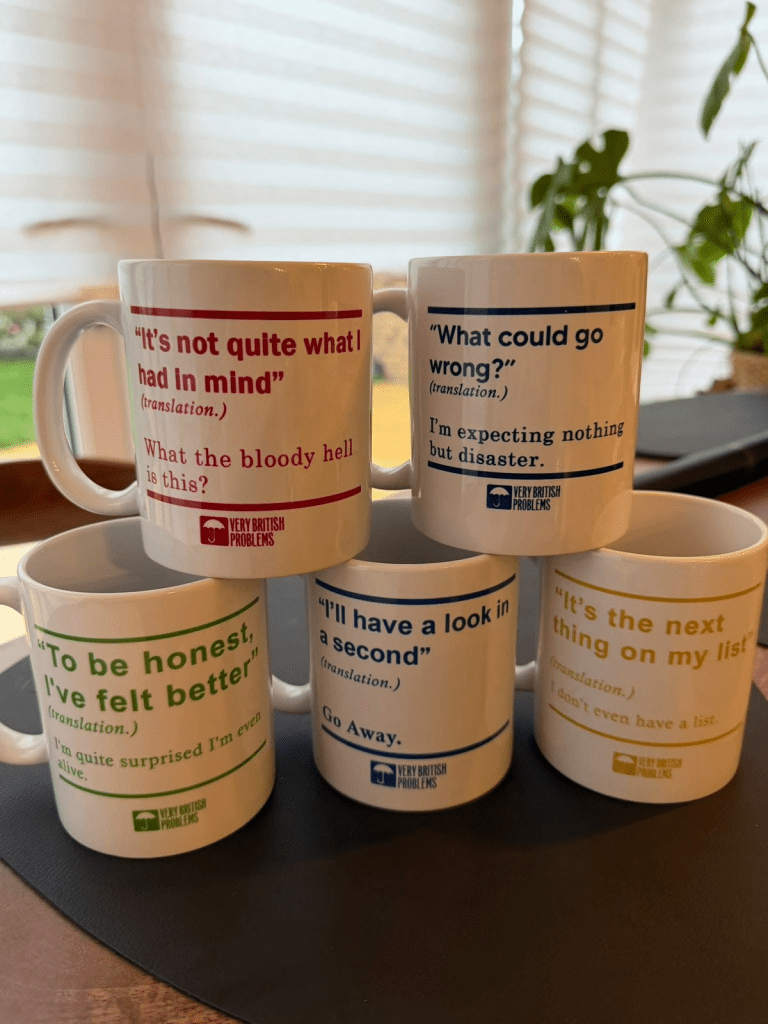
• Photo by: Very British Problems

    A couple of months ago, my partner’s mother, a lovely born-and-bred Brit with German ancestry, asked me something that I have been pondering on this whole time – and will probably continue thinking about it for a few more years:

    – So, do you identify yourself as British or Belarusian at this point?

    It is difficult to say ‘I’m British’ when you don’t have a British passport yet and they continue to move the goalposts on when you might qualify for one. At the same time, 6.5 years outside of my country of origin do cause a mismatch between what is written in my one and only passport and whom I see in myself.

    I notice both Britishness and Belarusianness about myself. Let’s look at both!

    Why I (partially) identify as British

    • I value my time

    My work-life balance is my mantra. Yet, when it comes to working time, I hate to see when it’s wasted in meetings that could have been emails, unnecessary chit-chat or arguments for the sake of arguing.

    The same standards are held for personal time as I hate faffing about, people running late without giving me a heads-up or not knowing what’s happening.

    • I endeavour to be diplomatic and am not comfortable with confrontation

    We have all heard about ‘sh*t sandwiches’ when constructive criticism is masked with a layer of praise at the beginning and at the end so that another person’s feelings are undisturbed. Most Eastern Europeans naturally fail to read the ‘sh*t’ part behind all the diplomacy and good stuff. We are too used to being surrounded by straight shooters who don’t worry about being careful with their feedback. I have moved on from my original straightforwardness and prefer to beat around a bush for a while before saying what I don’t appreciate about the other person.

    • I have become pragmatic when the choice is between turning the heating up or putting on more clothes

    ‘Putting on an extra jumper is free’, said no Belarusian in their first year of moving to Western Europe.

    In my native country, you get central heating without having any say in what sort of temperature you are going to get in your own house. It’s all decided by a local council, regardless of whether you like it or not. In winter, people walking around their flats in shorts and T-shirts and opening windows for the night are common in Belarus. ‘Oh, but that’s great’, I used to think. ‘What a waste, and I’m suffocating!’ is what I think nowadays.

    • English is my go-to language

    I might have gone a bit too far in embracing the English language🙂 90% of my playlists (both music and films) are in English, I sometimes struggle to remember a Russian equivalent of a word, and my mother (who only speaks Russian) is being slowly driven insane when she has to speak to me and I take forever to remember a translation before giving up and googling it. And yes, I do see dreams in English.

    • I stayed in the UK during COVID restrictions

    When COVID restrictions hit the UK back in 2020, some people, especially those who were at liberty to work from home and remotely, went back to their native countries to enjoy less stringent limitations – and to make their money go a longer way. In Belarus, they famously did not have any COVID restrictions whatsoever.

    Many people were asking me if I was going to go back for a few months to enjoy my life despite the pandemic. I did not. And it didn’t even cross my mind to go. Because when you commit to a country, you commit – for better or for worse, in sickness and in health.

    • Life is unbearable without a cup of tea!

    Oh, how can one even survive a winter without at least a cuppa a day?! Don’t get me wrong, they do drink tea in Belarus, but the go-to drink there is coffee, and that used to be my usual move. Now, when I’m sad, frustrated, tired, overfilled with joy or just want a good excuse to procrastinate – I go ahead and make tea. With milk, no doubt!

    Why I (still) identify as Belarusian

    • I would NEVER throw rubbish on the street

    There’s an old joke about a Belarusian who got lost in a desert. For days, he was wandering around, struggling to keep his mind straight and thinking if he would ever be able to see his family. Finally, a rescue team found him and brought him to the nearest town in a helicopter. As he got in the car to be taken to the hospital, he murmured his little request to stop by at the nearest trash bin, saying it was a matter of life and death. Befuddled, the driver fulfilled the request and stopped. The Belarusian slowly crawled out of the car to put an apple core into the bin, as he was holding on to that apple core this whole time, not letting himself throw it away in the desert where there were no bins…

    Many a true word is spoken in jest.

    • I love speaking Belarusian and get incredible joy from doing it

    Recently, I have attended a Christmas party with my Zumba group and some of its alumni. As a couple of girls from Ukraine and I were vaping on a balcony, they spoke English in front of me so as not to be rude. One of them knew where I was from, the other one didn’t. I switched to Belarusian (not Russian, they are from Ukraine after all!) and suggested that, if they wanted to speak Ukrainian to each other, it wouldn’t be rude at all as I can understand their language. Alas, my speaking skills in Ukrainian leave much to be desired (I never learned it!), so I suggested I’d stick to Belarusian while talking to them. After overcoming the initial shock that I could actually understand them and they could understand me perfectly, one of them said:

    – You know, I have just realised it’s the first time ever I hear someone speaking Belarusian! And I had no clue we could understand each other’s languages even though we never learned them!

    Probably one of the loveliest moments in my life!

    Even though Belarusian is not widely spoken and most of us stick to Russian, I am proud of my native language. It empowers me to understand most Slavic languages. It’s like speaking a Slavic Esperanto, except for the fact that Belarusian is not artificial.

    • I am up to speed on news, jokes and memes from my native country

    Belarusian media in exile are the first thing I open to read the news (BBC comes second – sorry!) My Threads feed has barely gotten rid of jokes about Igor who got drunk and walked back home. I still make jokes about something being ‘a troublesome business’ (‘khlopotnoye deltse’), which can only be comprehended by a Belarusian.

    I cried out of joy the other day when 123 political prisoners were released. I cried even more when I learnt that the Belarusian diaspora managed to collect donations of €123K in total to help those people get back on their feet in less than 4 hours (as of now, less than a week later, the sum has more than doubled). Might not sound like a lot, but that’s impressive for a small nation.

    •  I do watch ‘Love Actually’ every Christmas

    And the fact that Brits don’t appreciate this film (and my British boyfriend has NEVER heard of it until our first Christmas together) flies over my head!

    If your Facebook friends are predominantly Belarusians, your feed on December 25th is full of pictures of their Christmas tables and a telly in the background showing ‘Love Actually’. I’m NOT kidding! Our national Christmas pastime is watching a British film that is mostly ignored in its native country. CRAZY!

    So, who are you then, nationality-wise?

    For now, I am somewhere in between. It might stay like this forever, as I have no idea what’s going to happen even in the next 5-10 years. That’s the journey of being an immigrant – you live in a state of constant lack of clarity and uncertainty for a while.

    I do see similarities in two nations. At this point, I actually see more similarities than differences. Both nations are super-resilient in hard times. Both show tremendous solidarity when there is a challenge. Both Belarusians and British resort to humour to make things more tolerable. Both look after their homes rigorously and follow through on the ‘my home is my castle’ motto. It’s a tremendous honour to belong to both.

  • Whenever I crave a bit of showing off, I share a very simple fact about me – I speak 5 different languages.

    OK, two of them are my native ones, Russian and Belarusian, so I can’t really take credit for them. I just happened to be born and raised in a bilingual country. I do take credit for speaking English, German and Romanian. Whenever I mention the latter, eyebrows are raised and more questions follow (which is a good conversation starter, by the way), and when that happens, I just continue telling the truth – I have some Romanian ancestry, so it was important for me to learn the language my great-grandparents used to speak. I am yet to pay the same tribute to Latvian, though.

    If you are yet to get used to English (or any new language, for that matter), I happen to have a few pointers for you based on what has worked for me.

    How do you even know if you have achieved proficiency in English?

    Apart from formal exams, there aren’t any particular checkboxes you need to tick off to claim being proficient in English. My personal top three signs, though, are:

    • You don’t just speak the language – you think in that language! And/ or perhaps talk to yourself using your adopted language instead of the native one.
    • When you are furious or annoyed, you naturally swear in your new language. Despite confusing my boyfriend a few times with a loud ‘Blyat!’ or ‘Pizdets!’ exclamation of frustration, I mostly use the f-word in different combinations these days.
    • And my personal favourite – sort of a writing on the wall for your native language – you start dreaming in your new language. If your subconscious has fully embraced English, you’re good.

    My top tips for achieving proficiency

    Spoiler alert – I don’t have any magic bullets for you. Getting fully comfortable with a foreign language takes time and efforts, no shortcuts here. There are, however, a few things I found to be most helpful, so let’s take a look at them:

    • Surround yourself with the language (and be prepared to succumb to it!) Change your Netflix settings to English. Listen to songs in the language you want to master. (If it wasn’t for me falling in love with the boy band Five when I was 11, this post would have probably never come to life) Read books and articles in that language, including the news. The more you expose yourself to English, the quicker you embrace it.
    • Talk to native speakers. I know this can be daunting. I know you are terrified of making mistakes. Think of each conversation you have with a native as a small victory. Think of a smart word you have learned and see if you can fit it into the context. (I am still super-proud of myself for using the word ‘Geschwindigkeitsbegrenzung’ – ‘speed limit’ – when talking to a stranger on a bus from Munich to Frankfurt!) Offer help to a native speaker if you spot one – they won’t dare to be ruthless to you for making mistakes! Or, if you are a party animal, try to see if you can find a native speaker willing to talk to you at a fun gathering! My command of Romanian probably peaked at a New Year’s party in Istanbul where a lady from Romania was impressed with the sheer fact that I could speak her native language.
    • Translate things you hear and think about in your target language in your mind. The key difference between knowing a language and mastering it is that, when you get to the latter stage, you THINK in that language, instead of translating stuff from your native one to the target one. But you can’t achieve proficiency unless you successfully practise the ‘translation mode’ a million times in your mind and make it a routine for your brain. At some point, it will naturally transform into thinking in your new language straight away.
    • Make it fun for yourself. Write down newly learnt words in a cute notebook. Find some apps for your phone that would make it fun – and easy for you to practice. (The trick here is that you are on your phone most of the time anyway, so you don’t get an excuse of not having a textbook at you.) If you are tech-savvy, make ChatGPT your personal tutor in a new language. (and check out this article with helpful tips) Speaking of AI, how about writing down a list of things you find to be fun and asking ChatGPT about ways to combine these with learning a language?

    Like I mentioned before, getting to proficiency in a new language will take time. You might as well make that process enjoyable and empowering for you. There’s a limit to how much grind a human being can take.

    So, you never struggle with English then?

    Oh hell, no. Learning a language is a never-ending process. It’s like the horizon – as you move towards it, you progress but never reach it.

    And let’s face it, English is not easy to learn! There is no ham in hamburgers, and pineapples have nothing to do with either pines or apples. Mangetout is pronounced ridiculously, and my boyfriend almost peed himself when he heard me saying it as ‘manjetoat’.

    The one thing I completely fail at is fighting in English. I somehow lose half of my vocabulary in the heat of emotions and have to make do with the leftovers. Whether it’s a small fight at home about my partner not washing the dishes or a bigger one with a Ryanair customer service agent at the Dublin airport, I do struggle. (Bold of that lady talking down at me to even refer to herself as someone working in customer service, more like customer disservice…)

    Makes me wonder if in situations like this I should just switch to Russian and sound like DiCaprio in this video?

    How language changes identity

    There have been numerous studies suggesting that multilinguals wear different hats depending on the language they use at any given moment. My personal experience definitely echoes those studies.

    Both my ex and my current partner pointed it out to me that my voice sounds completely different depending on which language I speak, saying ‘it’s as if a completely different person starts speaking!’ When you communicate in English, especially in Britain, you are expected to sound polite, diplomatic and averting confrontation. Russian-speakers tend to be more blunt, straightforward and – to a point- aggressive. German, on the other hand, contrary to popular belief, sounds extraordinarily poetic (how come so few people notice it?!), but at the same time, it is very organised and disciplined. This is why I always listen to Rammstein when working on an assignment that requires 100% focus or the morning before an exam.

    This is the beauty of learning a foreign language. You get to experience yourself as a different personality, open the doors for other people in your life, get to explore something that would be impossible or at least very difficult if you had that language barrier.  There’s a Czech proverb saying ‘The more languages you know, the more you are a human being’. I couldn’t agree more!

  • They are moving the goalpost for me after all… It’s not set in stone, but most likely – yes.

    A couple of weeks ago, the Home Office announced pending modifications to the settlement scheme. Their proposal for immigration changes is now open for public consultation. (If, by any chance, you have 15 minutes to spare and would be happy to contribute to it, here’s the link) My gut feeling, though, is that the public consultation won’t change anything, not in my favour anyway, so we might as well summarise how my life is going to be affected if and when the changes come into force early next year.

    • Instead of waiting for another 3.5 years to get an indefinite leave to remain, I’ll have to wait for another 8.5 years.
    • OK, actually, maybe not that long. There is a very nice perk for those who can speak English at C1 level (and, let’s face it, I could nail C2). For the 30 years I have dedicated to learning, practising and mastering the English language, I can get… a 1-year reduction in the wait time!

    Yipee, thank you very much!

    • If I get a wage increase that would automatically put me in a different tax bracket (which would result in having less disposable income for me), I can get my 5-year waiting period back.
    • If I volunteer (and I do), I can also get a reduction in the waiting time. What kind of reduction that would be and how much volunteering one needs to do to qualify for the reduction, remains vague.

    I deliberately omit things like having no criminal record, paying taxes and NI contributions, not claiming benefits etc. because to me these were the default settings anyway. How could I stay on my work visa without paying taxes and contributing to the public economy? How could I get a criminal conviction in the UK without being deported immediately?

    I’m not going to lie – I threw a tantrum at home the night of the announcement and pouted on those proposed changes for a few days. But after having switched to my analytical mode, I started pondering on what a move to a new country and integration into the society actually mean to me.

    Getting a permanent settlement and a passport of your new homeland is, no doubt, the endgame. To me, it’s not about claiming benefits. I have been in employment since I was 19 years old. I have always worked, sometimes crazy hours, sometimes at the expense of my health and the time with my family. I was raised this way! Unless something terrible happens and I end up in a situation when I am physically incapable of working, I am not going to claim any benefits. To me, it’s about the country making a commitment to me after all the contributions I have made to its economy and to the community I live in. All I want is for the UK to eventually acknowledge me as one of its own.

    But is that the ONLY goal an immigrant can pursue in their new homeland?

    One of the pillars of the new ‘earned settlement’ scheme is integration. That’s the pillar I certainly stand behind. And it made me think that integration comes in so many different shapes and forms. Ones you can’t codify in an immigration scheme. Ones that don’t necessarily lead you to a passport. But these are the things that actually matter in life.

    Building friendships with locals, ideally those who are not other expats from your own country.

    Accomplishing something meaningful in your job, something your company relocated you for in the first place.

    Understanding local jargon and embracing it.

    Mastering the language and polishing your accent so that you are mistaken for a native speaker. (I have been mistaken for Irish so many times I lost count…)

    Building a life with a partner you met here and with whom you managed to build a beautiful relationship despite all your cultural differences. (and all the things that freak him out about your ways)

    Asking your retired customer if he could provide you with a reference for a new volunteering opportunity you are excited about and getting a response ‘I will be HONOURED to do so!’

    Baking kick-ass mince pies that can only be rivalled by those made by my mother-in-law, a born-and-bred Brit.

    I’m just a human being and not a politician. Which means for me, people come first, not politics. If you look at immigration as a system of KPIs, yes, a permanent settlement and a passport are the ultimate goal. But there are a lot of crucial milestones that truly show you are committed to your new country. When you achieve those and have many more to look forward to, waiting a bit longer or contributing more in taxes don’t really count as problems. 

    And the Reform party is welcome to claim any benefits I could ever have been eligible for. Maybe it will help to actually raise those £350m per week for the NHS that were talking about during Brexit

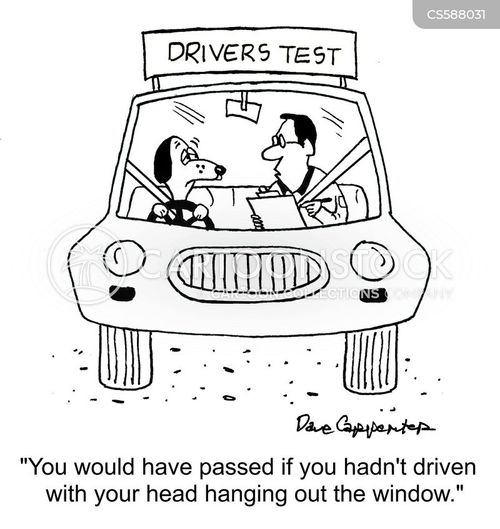
  • Having completed my big move to the UK, which involved transporting my cat from Minsk to London by car back in 2019 (that’s a completely separate story), I didn’t bother too much with a driving licence. After all, for the first year in the UK, I could use my Belarusian licence, and it did come in handy. In summer 2020, when the pandemic restrictions were loosened up a bit, I rented a car and did a road trip around England, which was awesome! Then, if you live in London, you don’t really need a car most of the time: Tube, buses, Uber… You don’t really bother with it.

    Fast forward to 2024, when my partner and I started thinking about moving outside of London, it was time for me to do something: I could not live outside of London without a car. But to start with, I needed a driving licence.

    One of the downsides of moving to the UK from a not-so-civilised country is that you constantly have to prove yourself. You have to prove you are trustworthy, you have to prove you are competent and that you know your stuff. You have to prove you have the right to be among first-world people. And you have to prove that you can drive, even though you used to drive in your own country for 10 years and managed to drive your cat from Minsk to London (ca. 2,000 km) and then return your car back to Belarus in one piece.

    The process itself is pretty straightforward, so I won’t be going into much detail describing it. The DVLA will always have the most up-to-date guidance anyway. In this article, I will solely focus on my personal experience and recommendations.

    An important disclaimer: I am NOT getting any rewards, etc. from the service providers mentioned in this article. These are the apps and services I found very helpful in my journey to a UK driving licence, and I am more than happy to recommend them as a satisfied customer without getting a commission. (Although, if any of those service providers want to thank me, I can’t say ‘no’ to an Amazon gift card…)

    Theory test

    The theory test is comprised of two parts – multiple-choice questions and a hazard perception test. The first one doesn’t pose a challenge for most people. You buy a few books, read them, realise that 80% of the content is just common sense and learn things like speed limits, traffic signs (there are some that were news to me), etc. The hazard perception test is a completely different story.

    The idea of the test is that you are shown a few CGI videos depicting a road and its surroundings as if you were a driver. You need to respond to a hazard that starts developing by clicking a mouse. A click in that scenario represents an action you would be required to do as if you were actually driving, such as stopping, slowing down or swerving. A hazard can be anything, such as another vehicle joining the road from a concealed entrance, a child running into the road in front of you or a bevy of swans taking a nice stroll in the middle of the road. Sounds easy, right?

    Well, just like many other people, I failed mine the first time, despite having done practice tests from the DVLA almost impeccably a thousand times. In fact, I found that doing so was actually the reason my test was such a disaster! The videos you get in practice apps and the ones you get in your test are completely different. And if you practise too many times with the same set of videos over and over again, you just get too used to them and get blinded by the hazards you have learned almost by heart.

    For my second attempt, I got a paid app called Driving Test Success, and these were £4.99 well spent. Although the app’s content is very similar to the one you get from the DVLA, it has questions that are worded a bit differently, and you get to practice your hazard perception test in a different manner, too. It enables you to learn the material and to gain the test passing skill without learning the questions by heart, which means you are more attentive and not restricted by the practice materials during the test itself. Additionally, the app will give you a refund on the test fee if you fail it, subject to you having completed all practice materials. Happy to say that I didn’t need a refund.

    Practical test

    So, this one is a bit trickier. Training for a practical test and passing it wasn’t a breather, but that wasn’t even the most complicated part. The biggest challenge was actually booking a test!

    The DVLA has already announced measures it is taking to reduce the waiting times for driving tests, and it’s about time! When I was booking mine, it was a complete mayhem. You would have to be up on a Monday at about 5:50 to be at your computer no later than 5:58, log into the test booking system and wait impatiently for the slots to drop. Two minutes later, all slots would be gone. And the slot you have managed to book, if any, would be about 6 months away. Yep, not cool. Especially if you fail your first one. I honestly hope the DVLA’s new plan works out.

    Needless to say, I failed my first attempt. The only thing I was upset about is that I would need to wait for another 6 months for my next one. I didn’t in the end but more on that later. There’s yet a funny story to be told about my first attempt and why it was unsuccessful.

    My first try was on a gloomy weekday afternoon in February, when both the traffic and the moods were low. I answered both safety questions of the examiner, did the parallel parking like a pro and drove on along the oh-so-familiar roads that my driving instructor showed me around a million times. There was a hospital nearby, and multiple emergency cars started a drill, so I had to pull over and stop a lot. The examiner got annoyed at me one time that I didn’t stop soon enough. That’s when I though I failed and that the pressure was off. (Spoiler: no, it was only a minor fault).

    At the end of my test, I elegantly parked in front of another learner’s car and waited for my instructor to approach so that the examiner would tell us the outcome. It turned out that I failed at the very last minute of the test! Apparently, what I considered to be an elegant parking manoeuvre of an experienced driver meant ‘you were pulling over too close to a parked vehicle and too quickly for my comfort, so you are getting a major fault for clearance’ to the examiner. Damn! (My instructor couldn’t get over it for months)

    You can imagine that I got the same examiner my second time around, it was a peak morning hour of a weekday, and just 10 minutes before the test, I got an extreme urge to use the facilities (which were absent at the testing centre, so I had to run to the nearest coffee shop. I’m probably banned from it for good now). That was a perfect storm. I managed. A few days later, I had my lovely driving license in my mailbox. Felt pretty damn good.

    On my way to a UK driving license, I made a few right choices and a few mistakes. Here’s what I recommend if you are yet to embark on that journey:

    • Regardless of how good a driver you were in your native country, DO take a few practice lessons with an instructor. (I booked mine via AA) Remember, it’s not about how good you are at driving, it’s about how good you are at PASSING your driving test. An experienced driver knows those are two different things.
    • Until you pass your theory test, there is no need to rush and start your driving lessons, unless you haven’t driven for a very long time and feel you need months and months of practice. You can’t book a practical test unless you have passed the theory one, and while I do wish DVLA and any aspiring drivers all the best, I don’t have confidence yet as to whether your driving test can be booked less than in a few months’ time.
    • When you do manage to book a test, look for an instructor who works with that area and the test routes for your specific testing centre. This is VERY important, especially in London. Yes, there are no ‘official’ routes, and those you can find online change all the time and aren’t very reliable. This is exactly why you need an instructor who knows the practices of your particular testing centre. That’s your best shot at familiarising yourself with what you are going to get at the test.
    • When your driving test is 6 months away, it can be disheartening. Especially if you are in a position when, say, you want to move outside of London and you do need a car and a license badly. If you find yourself in a situation like that, I can totally recommend an app called TestShift , which tracks any cancellations for your testing centre(s) and moves your appointment up whenever there’s a chance. I managed to move mine from August to April. And was happy that I could just pay £15.99 for a legit app instead of giving away hundreds of pounds to questionable characters who hijack test appointments and then resell them at ridiculous prices.
    • If you are going to take your test in London – brace yourself! Heavy traffic, temperamental drivers and spiral roundabouts with a million exits each (not literally!) can be a challenge even for someone who was born and raised in a big city. Don’t let it discourage you. Just think about how cool it’s going to be when you succeed and can tell people ‘oh yeah, I passed my driving test in London. Good luck trying to intimidate me!’

    Speaking of roundabouts – how crazy is this sexy one in Swindon? https://www.youtube.com/watch?v=6OGvj7GZSIo

    What is your experience with driving tests, either in the UK or abroad (or both)? What would you recommend to future UK drivers? Share your thoughts in the comment section!

  • I was once asked what Brits and Belarusians have in common. First thing that came to mind was that both nations like complaining. And that might be one of the reasons I feel so comfortable living in Britain.

    Today, though, I’m going to pause that for a minute and focus on positives of being someone from a country with notorious reputation (or the name of which is followed by ‘oh, where is that?’) whose passport causes confusion mixed with curiosity wherever I go. Turns out, there are some secret perks to that.

    You know everything about travel regulations, visas, etc.

    You’ll never be one of those people who learn their passport is due to expire very soon right before you are supposed to board an airplane. Because you know by heart when your passport and all the visas you need to visit almost any country in the world are expiring. You check your passport regularly just to keep that knowledge fresh.

    No country has invented a tedious enough visa application procedure to put you off. You have already seen it all, you can get all the certificates, confirmations, etc. very quickly and you are ready for anything.

    And if you happen to plan a holiday and see ‘no visa required’ or ‘visa upon arrival’… ah, the happiness and joy! I once decided to go to Malaysia simply because a Belarusian doesn’t need a visa to get there. (Loved the country, visited twice more, would love to go again)

    You are underestimated

    Off the bat, people assume you came out of nowhere, never had any money or possessions, can hardly speak any language other than your native one and could probably only get a job waiting tables or cleaning toilets. It is very easy to surprise and impress them by simply telling the truth – that you have a university degree, a decent job in IT (otherwise, you would never have gotten a work visa to come to the UK in the first place), speak 5 different languages and was pretty well-off in your native country.

    You always have a topic for a conversation

    Asking a person where they are from prompts them to reciprocate, which is then followed up with lots of different questions about your country (some of which have been answered here). People are naturally curious, so when they meet someone from a country they have barely heard of, you are almost guaranteed a good conversation. Regardless of whether that’s going to be about the frequency of travel to your native country (and why exactly you don’t go there very often), the quirks of you being an East Slav or the language situation, escaping awkward silence is not a problem.

    You are incredibly resourceful

    Working 24/7 when your country gets involved in the attack on Ukraine and you need to make sure your co-workers back there are evacuated and safe and the customers don’t terminate their business with you? Not a problem. Learn a new language from scratch and practise it with any native speaker you can find? Thank goodness I live in London and finding people is not a problem! Using public shower facilities despite not having any towel, hair dryer or even slippers on you? Eh, I’ve seen and done worse…

    When you constantly have to prove your worth and start your life almost from scratch in a new country, you don’t have time to be depressed or lost. You just get up and keep grinding. You can’t afford to be jobless or unhealthy. And when you are used to that, it doesn’t really seem hard.

    You get a discount on private healthcare and beauty procedures (assuming you are OK to visit your native country for it)

    My therapist, German tutor, beautician, hairdresser and dentist are all based in Belarus. You can imagine the rates back there are a bit more competitive than those in the UK. Thanks to the modern-day technologies, the former two are always a single call away. It’s a bit more complicated with the services that require your physical presence, but back in the good old days with direct flights between London and Minsk, a week-long trip to fix your teeth, get a couple of collagen shots and dye and cut your hair would pay for itself and even save you some money. It is way more complicated now, but when I do travel to my native country to see my mum, I do have my calendar filled up with appointments quickly. And boy does is save me money…

    You keep your nose clean as you can’t afford to get in trouble

    Even a minor transgression can cost you a passport of a first-world country that you have been dreaming about for years. A couple of speeding fines can get you deported or at least substantially defer the time for obtaining citizenship. When you apply for a citizenship, you have to disclose your parking fines, regardless of whether they have been paid or not. If there are a bit too many of them, you’re screwed!

    Technically, you have the money to pay fines for misbehaving but, given you don’t yet have a property in your new country, need a lot of cash to pay visa fees and can’t rely on your parents to help you out, it’s easier to just not bother with being up to no good. You can still have fun, mind! You are, however, a haven for those who crave calmness and trouble-free pastimes. It’s surprising how many people actually find it attractive.

    What would you say are the perks you got by being born in your native country? Do they make you happy or proud (or both)? Share your thoughts in the comments section, it appears we are about to learn a lot!

  • When someone learns where I am originally from, the most common response I hear is ‘Oh wow, I don’t think I have ever met someone from Belarus before!’

    That’s true – we are a rare breed, at least outside of countries where many Belarusians ended up in the past few years, such as Poland, Lithuania and Georgia. Despite the (not-so-ungrounded) notorious image of my native country, to this day, it remains a terra incognita for most people in the world.

    While I don’t have the power or even the will to educate the entire global population about Belarus, I thought I’d prepare a brief list of things people usually ask me about and my usual responses. Well, maybe with a bit more honesty this time.

    Where is Belarus?

    It’s quite a small country located in Eastern Europe between Russia, Ukraine, Poland, Lithuania and Latvia. When I say ‘quite a small country’, I mean it is on a global scale. If you look at the list of European countries by square area, you fill find my native country sitting comfortably at position #13 out of 51.

    So, is it a part of Russia?

    No! It’s a separate country that has its own history, language, currency, etc. And while we’re at it, this is the best question to piss a Belarusian off. Can’t really speak on behalf of other nations, but I would steer clear of that question when speaking to Ukrainians, Lithuanians, Latvians, Estonians, Georgians and people from any other countries adjacent to Russia. Better use ‘is it next to Russia?’ or something along those lines.

    So, which language do you speak, is it Russian?

    Yes and no. The most common language in Belarus is indeed Russian, which is a result of centuries-long Russian policy of eradicating indigenous languages in countries that were part of the Russian Empire and subsequently the Soviet Union. We do, however, have our own language, which is – unsurprisingly – called Belarusian. Both are learned at schools, and there are people who only speak Belarusian out of principle, especially since some well-known events of 2022.

    I treat both as my native languages as my father was Belarusian and my mother is Russian. And when I say that I speak 5 different languages, I do include Belarusian and Russian into that count.

    How different are Russian and Belarusian?

    Both languages refer to the Eastern Slavic group of languages, so they are quite similar. Belarusian is certainly more similar to Russian then, say, to English. It does not mean, however, that you can perfectly understand Belarusian if the only language you speak is Russian. Sometimes it can lead to comic situations.

    There is an old nationalist joke in Belarus about how confusing Belarusian railway stations can be to Russians. The word ‘другi’ (drugi), which means ‘second’ in Belarusian, is very similar to the Russian word ‘другой’ (drugoy), which means ‘another’. That means that an announcement at a train station in a Belarusian town ‘Цягнік адпраўляецца з другой платформы’ (the train departs from platform 2) may confuse a Russian speak who will be looking for ‘another’ platform.

    One more example is a beautiful expression ‘маешь рацыю’ (what you say makes sense), which for a Russian would sound like ‘you have a walkie-talkie’.

    Isn’t your country in the EU?

    Alas, no! I can’t even visit most European countries without obtaining a visa in advance, let alone coming to any European country to live, work, study, etc.

    But to be fair, not all European countries are by default a part of the EU. It applies to, say, Moldova, Albania, Bosnia and Herzegovina, North Macedonia, Serbia and some others.

    Why can’t you just go to Europe whenever you want?

    I only have a Belarusian passport, which means I have to get a Schengen visa to visit most European countries. There are exceptions, the most notable one being Ireland as, to hop onto a flight to Dublin, I need to get a separate Irish visa first!

    Luckily, in some cases, you can get a long-term Schengen visa for multiple entries, so I am sorted until 2028, but will have to apply for a new visa then as I won’t have qualified for a UK passport by that time yet.

    Why aren’t you going home more often?

    Ok, so this is a bit complicated, and some people don’t even believe me when I tell this story.

    Until May 2021, there was a direct flight connecting London and Minsk, and I could get there and see my family in as little as 3 hours. The flight even operated during the covid times, so I was lucky enough to go and see them in summer 2020 despite the restrictions (had to self-isolate for 2 weeks upon returning to the UK, though).

    Then, the story with the Ryanair flight happened. If you are one of those lucky and happy people who missed it in the news, the premise is that a Ryanair flight from Athens to Vilnius was forced to land in Minsk, and – surprise! – one of the Belarusian activists in exile turned out to be a passenger on that flight. Most other passengers were EU citizens, so you can imagine European governments were not very happy about it and quickly banned any air traffic between Belarus and other European countries. Until February 2022, it was possible to get to Minsk relatively easy with a layover in Moscow, but then… you know… I hope I don’t have to explain what happened then!

    Is it safe to travel to Belarus? It’s basically in the warzone!

    Despite my tribulations with entering my native country earlier this year, I wouldn’t be so dramatic. Sadly, Ukraine is indeed a warzone, and I can’t wait for it to achieve peace and get its normal life back. It doesn’t mean Belarus is unsafe, as no military action is taking place there. There are other reasons for concern, which is why FCDO advises against all travel to Belarus. But your chances of being shot or killed by a bombshell in Belarus are very low, if that’s what you are asking.

    Why don’t Belarusians just leave the country?

    Oh dear, where do I start on that?

    We are not exactly welcome much in the world. In addition to the visa restrictions mentioned above, there is also a matter of some countries in general (and specific people in particular) who blame Belarusians for their government’s involvement in the events of 2022. For example, despite me having lived in the UK for many years, I am banned from doing some financial operations with my pension account just because I have a Belarusian passport. The officials claim that this is to encourage me and other Belarusians to stop our country’s involvement in you-know-what. How exactly am I, a person with no connections to the government whatsoever, is supposed to do that is a mystery to me…

    Next, life in Belarus is not terrible. People still go to work, enjoy the outdoors when the weather permits, go shopping, visit theatres, buy properties, and for most of them, life is good – or at least not bad enough to move elsewhere.

    Lastly, relocation is not for everybody. Not that I’m trying to be big-headed and say that I’m smarter or better than others. I just know that, even when you move to a different country at a relatively young age, with a job secured and some money in your bank account to set up a new life, it is a big challenge. You leave your previous life behind, and it might be full of things and people you care deeply about – your family, your property, the lifestyle you are accustomed to. Not everyone is cut out for that, and not everyone wants to subject themselves to the trials of being a migrant. Am I happy that I moved to London? Absolutely! Would everyone be willing to do the same and walk the walk? Oh bloody hell, no!

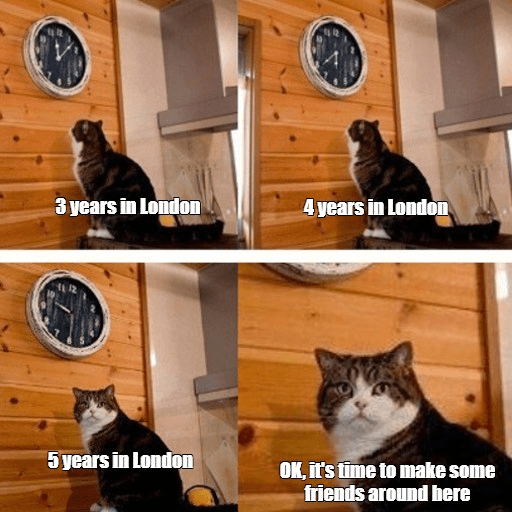
  • In my first few years in London, I heard way too often that making friends in this city is virtually impossible. People would say that very few stay in London for long enough to build and maintain long-lasting friendships, that everyone is way too busy with work and all the fun stuff the Big Smoke has to offer and generally, no one cares about anyone.

    (Spoiler alert: this isn’t true)

    For some reason, I chose to believe it and, for the first few years of my live in London, I didn’t even bother. I had two wonderful friends back in Belarus, who subsequently moved to Ireland and Mexico respectively, which made it even easier for me to visit them whenever I had a chance to. During the pandemic, we had to nurture our connections online anyway, and I, alas, maintained that inertia for quite a while. Anyway, life was good – or at least not too bad.

    This post would probably never have come to life if it wasn’t for my partner. He doesn’t have many friends himself despite being a born-and-bred Brit. His friendships don’t extend past a couple of school friends. But at least he and his friends are in the same country and can meet up whenever they want! So, at some point, he started questioning me as to why I haven’t built any new friendly relationships in my native country. Having listened to my lamenting about lack of time, being introverted and, hence, pretty happy with the two fantastic friendships I already had and many other things, he responded:

    – Well, I’m just worried that, if something happened to me, you would be here all by yourself, with no one to support you and no one to help you through it. It’s a good thing you have Julia and Alex, but what if they can’t come and visit you here when you need it?

    I decided to ignore it. Until the day when something happened, specifically, my partner got into a horrible accident and had to spend three weeks in a hospital. Despite my mental toughness and tons of experience of dealing with crap situations (I’m from Eastern Europe after all!), this was a wake-up call for me. It was the time to challenge the things that people used to tell me when I first came to London.

    So, how do you find friends in London?

    Well, it’s complicated and easy at the same time.

    In essence, people become friends when they like each other and spend time together. Someone can become intrigued about you within less than 5 minutes, however, to build an emotional bond strong enough to last, you will need more than that. Much more than that.

    With that simple science behind it, I started looking at what would be the best place of meeting new people and building relations with them.

    A workplace might be the most obvious answers, and one of my friends from the Belarusian life is actually my work bestie whom I met during his time in the London office. Times where different then, though, and there was one thing that certainly contributed much into building a relationship – we were all in the office all the time. Nowadays, when some of my coworkers moved out of London and don’t frequent the office, building new friendships there was a bit impractical. Unless I wanted to make friends with an office kettle.

    During my time at Bumble, I saw there is a ‘BFF’ mode that helps you meet people who are looking for friends. Frankly speaking, while this would be a beaten path for me, it still felt a bit too much like dating. With a lot of grind and a lot of ‘first and last’ dates to go through before you get to a point when you can call someone a friend. So I didn’t even try.

    I signed up for a couple of volunteering opportunities, which I found to be very rewarding and challenging in a good way. The problem was that it didn’t help me with developing friendships. Unfortunately, due to my work commitments, I couldn’t sign up for steady regular volunteering and would have to go for one-off engagements – which meant most people I met would do the same. Not something that gives you enough face time to forge a bond.

    Then it struck me. Why not look at something that I like and, hence, wouldn’t have a problem doing on a regular basis, and think how I can use it to meet and to hang out with other people? Having a shared hobby definitely helps in building rapport and laying a foundation for a friendship. Not to mention that the time spent doing what you love flies by and puts you in good spirits.

    During the pandemic, I picked up online Zumba classes (thank goodness we had YouTube back in 2020!), and even though I didn’t make much progress learning from videos without any feedback or regular schedule, it was something I loved and could imagine doing regularly. Another thing that I have been into for a long time is running. And while I used to see it as my introvertive hobby that helped me disconnect from the outer world for a while, I thought I’d give social running a chance.

    Good news – it worked!

    Despite all my shyness and insecurity and despite my deeply engraved belief that I’m a 100% introvert, I managed to build fantastic connections with amazing people. I can’t take much credit for it – it’s all them! Both in my Zumba community and in my running club, I was blessed with lovely friendly people who helped me open up and made me feel welcome.

    The only thing I could possibly take credit for is taking my time and being patient. Relationships aren’t built overnight. You need to show up and talk to people regularly to forge that connection and to make it develop. Sounds scary and complicated? It’s not! Laying a foundation for a friendship is beautiful. When you are bonding with other people, you are investing your time in something no amount of money can buy.

    This is SOOOO worth it! Cheering with my running friends for the founder of our club who was doing the London Marathon this year (and who’s also my friend now!) or hanging out with my Zumba girls in a park and breaking into a dancing impromptu just because we couldn’t help it are certainly on the list of my most cherished memories. And I look forward to seeing what other fantastic experience lay ahead of me.

    In the final reckoning

    If you are quite new to London (or just getting round to making new friends in the city), here’s what you need to remember:

    1. Don’t believe those who say building friendships in London is impossible. In a city of around 8 mln people, you will find those who are ready to open their hearts and arms for you.
    2. Stay as local as you can and try focusing on something you and other people have in common. A shared interest is the most fruitful soil for a new friendship.
    3. Be patient. Think of yourself as an artist who works on a masterpiece – it does take time! But in the end, that’s one of the most beautiful things you have in your life – a masterpiece named friendship.
  • You are in your early 30s, you divorce your partner of 10 years and send him back to your native country as he’s proven completely useless in life in general and in expat life in particular, and you end up being single in one of the biggest cities in the world. Depending on your circumstances and – most importantly – your attitude, this can be either fun or terrifying. When I found myself in that situation, I opted for the former and decided to make London my oyster in terms of living a single life.

    One of the perks of being an introvert is that you find comfort in being on your own and don’t sweat over going to the movies or to a play by yourself. On the other hand, the downside of having been in a relationship for a long time is that having company is now your MO. You don’t have a problem doing fun things on your own but wouldn’t mind having your other half to do it together.

    This is why I dived into dating pretty quickly after my breakup, but I still had the luxury of taking my time and looking at my options. Little did I know that, if you are in your 30s, you haven’t dated for a while and you get back to it shortly after covid, dating feels more like shopping in a clearance section of a department store… But more on it to follow!

    How is dating in London different from Eastern Europe?

    Having had the (un)pleasure of dating both in my native country (although a long time ago) and in London, I have managed to sum up the pros and cons of the latter.

    What I appreciated:

    • You can meet people from anywhere in the world

    The melting pot London is, it gives you an opportunity to have a date with a person from any, even remote, part of the world. (Some of which referred to where they were born as a ‘country’, even though it wasn’t…) Regardless of whether a first date leads to a second one and whether this person can become your romantic partner, at least you get to learn about so many countries and so many cultures!

    • (Most) people don’t see you as a gold-digger by default

    Whenever I read any social media posts in Russian these days, half of them is about dating – and half of them mention the word ‘tarelochnitsa’. The most accurate translation I found for it is ‘food digger’ – a woman who goes on a date with the only goal of eating out and her suitor picking up the bill. This is a great reflection of how East Slav men approach relationships: they want to come across as providers, but most of them can’t afford to be one, so instead of trying to make more money or to focus on other decent qualities, they label women as food (or gold) diggers.

    I don’t have a problem in splitting a bill, especially in London where eating and drinking out can break any bank. I am, however, unimpressed when the motivation for suggesting that we split a bill is coming from an assumption that eating and drinking at someone else’s expense is the reason I am on that date. Based on my experience, it’s more of an exception than a rule in the UK.

    What I did NOT appreciate:

    • Tons of grind before you meet a decent person

    When you are spoiled for choice, chances are, it is going to take a while to find someone who’s actually interested in a relationship, is willing to make an effort and not a total psycho. This means that some time is going to be wasted talking to weird people whose claims on dating profiles are way different from the reality. Sometimes, you can filter someone out by something very obvious, such as your date showing up to your first meeting in a blatantly torn pullover with a hole in it bigger than London Eye, or your counterpart on the app cancelling your first dates one after the other only to completely put you off by sending a d*ckpick.

    Other times, you can waste months talking to and occasionally meeting with someone who lives outside of London but claims to be moving back to it shortly because of work. When the alleged move is supposed to happen, the person may end the communication with a nonsense text message, only to text you 6 months later (when you are already in a relationship with someone else). If you haven’t yet done so, make sure you learn how to block people on WhatsApp.

    • Too much choice – which applies to men, too

    London is full of temptations. Those who have moved here recently, especially from a different country, can’t help it but take advantage of whatever the city has to offer. Unfortunately, sometimes it applies to dating where feelings of others are being ignored, meetings turn into a game of whether you get a ONS from a girl or not and, if nothing else, you can always say you have decided to leave the Big Smoke and move elsewhere. (Relocation is optional in that case) When you can get away with a lot of things, chances are, you are going to take advantage of it.

    So, what am I supposed to do then?

    There is a number of things I wish I knew sooner to save myself many hours wasted on meaningless chats, crappy dates and situationships that were neither fun nor leading anywhere. Each to their own, but a few of my lessons learned can be helpful for anyone who’s embarking on a dating journey in London, regardless of whether you are a man or a woman. I’m not including things like ‘mind your safety’ and ‘don’t reveal too many of your personal details too quickly’ – but those obvious things still apply, just to be clear!

    1. Self-reflect on what works for you and what doesn’t

    You are the only person who can define your own boundaries, what works for you and what you’re not going to tolerate ever. For some people, sex on a first date is the only way of building relationships that they accept. For others (like me), this is not acceptable. Letting others cross your boundaries is not how you start a healthy relationship.

    Be honest with yourself and think what your non-negotiables are. The list shouldn’t be too long, though (3-5 items on the list should suffice), after all, you are dating real human beings that don’t happen to be flawless. (Let’s face it, nor am I)

    You might even want to write them down to avoid tons of thoughts going through your mind and to make it official, at least with yourself. And regardless of how lonely you feel or how tired you are of sorting through, make sure you can compromise on most things, but not your non-negotiables. No relationship is worth losing yourself.

    2. Don’t stay pen friends for too long – go ahead and have a short date

    A real-life person and the way they come across in an epistolary form can be two completely different instances. Same applies to their pictures on a dating app – the pics can be too flattering or too old (or, worse, of a completely different person). Last but not least, you can’t know if you are going to have physical attraction to each other until you meet face-to-face.

    There is no point in wasting weeks or months in correspondence if, when you eventually meet, you or your counterpart are disappointed because of the gap between the image that was created online and the real person. Even if you don’t lie on your dating profile, your potential suitor might have built up a completely different perception of you in their heads. And vice versa.

    Go for a short date to see if the live convo is going to flow and if you want to meet again. Have a cuppa or a drink after work. Chemistry is formed between people, not via online chats.

    3. Cast a wide enough net

    Like I said, you will need to filter out a lot of people – and sometimes it might feel like a lot of work. If you happen to meet someone who’s your only one at the very first date you go after a breakup, you are either the luckiest person ever (go buy that lottery ticket to see if you are) or you haven’t exactly healed from your previous experience (and there might be unpleasant surprises coming up).

    Go ahead and chat to several people. See whom you like the most and – equally as important – who makes you feel liked and respected. Don’t settle for someone who seems to be OK but you don’t feel like it’s your perfect match. After all, that would not be fair to your counterpart either if you don’t feel excited about him or her.

    It is a grind sometimes. But it can also be fun and broaden your horizons regardless of who you end up with. Finding the right person takes time, but so do friendships, achievements in what we love, good health and any other things that truly make us happy!

  • If you are a single woman in your early 30s in London, the dating life can be hard. (and it’s probably worthy of a separate post) Tons of people who are not interested in any sort of commitments, shallow dates, cultural mishaps due to the multinational nature of the city – the list goes on and on!

    When you finally manage to meet THE ONE, that’s when the actual fun happens – the fun of figuring out how your life together is going to function despite you coming from completely different backgrounds and cultures and one of you (or both of you!) not speaking the native language of your other half.

    Throughout almost four years of my partner and I being together, we had lots of challenges stemming from our cultural differences – all of which we managed to handle, as you can probably imagine. Now that I have listed a few things (here and here) that struck me about life in London – and the UK in general – it is time to reflect on what it feels like for a British fella when he starts dating a girl from a mysterious East Slavic country. If you are from Eastern Europe, feel free to use it as a guide on how to surprise your British friends and loved ones.

    1. Eat sweet peas straight from a pod

    When I was little and visited my grandma’s garden in summer, I would always pick a few pea pods, rinse them a bit and eat them straight from a pod. The fresh sent of legumes just picked up from a vine, the excitement of opening the pod and seeing how many peas it got, the amazing taste when you put it in your mouth – one of the best childhood memories!

    Fast-forward 25 years to my life in London, I ordered some produce from a lovely farm in Kent, with pea pods being among them. When my born-and-bred English partner saw me eating those peas straight from a pod, he was nothing but shocked!

    – How can you do that? Is that even safe?

    – Of course it is! I’ve been doing it since I was three years old!

    Little did he know what would happen next. Given the pods are very sweet (although I doubt they are edible), I folded an empty one and chewed on it for a few minutes. The look on my partner’s face was priceless! 😊

    2. Only use marked pedestrian crossings and never cross on red

    ‘Nope! I’m not doing that! This is illegal, and I’m here on a work visa, so I can’t be up to no good!’ It took my partner a while to persuade me that it’s pretty legal (or at least not illegal) to jaywalk in the UK, as long as you don’t cause an accident. Yet, if I can use a zebra crossing, I will do that. Back in my native country, you can get a serios fine from the traffic police, which comes up out of nowhere, at exactly that only time when you decide to bend the rules a little and cross the road where you wanted to, not where you have to.

    OK, that might apply to Belarusians more than to Russians or Ukrainians, because I come from a nation that tends to:

    3. Be OCD about following the rules – and tidying/ cleaning stuff up

    When massive protests swept across Belarus back in 2020, some people joked around that the streets were cleaner after the protests than they were before. I wasn’t in the country at that time, but I’m pretty sure it’s not a joke at all. Belarusians are maniacs when it comes to cleaning and tidying up, to the extent we don’t really find it funny when Sheldon from ‘The Big Bang Theory’ thought a party where he got to clean up his friends’ closet was a great one. Boy, that IS a dream!

    If you drop litter on a street in any Belarusian city, at best you will be met with scorn and looks sending you to the hottest part of the hell. Someone might approach you and say ‘excuse me, I believe you have dropped something, you should pick it up’. Those who prefer passive aggression to a polite but open confrontation would roll their eyes murmuring ‘oh, that must be a Russian, huh?’

    I can’t really say where it’s coming from, and why it’s so deeply enshrined into Belarusians. (Sometimes I think it might have become a part of our genes) My best guess is that it’s our way to gain control over at least something in our lives. We’ve hardly had any democracy in the past hundreds of years, the opportunities for professional development and wealth-building are extremely limited (unless you move elsewhere), so if you are not ready to move to a different country, there’s only so much you can do to have a grip in your life. Picking up litter and keeping your flat tidy is one of the few.

    4. Tell them your main holiday of the year is the New Year. Christmas is fine, but you’re actually celebrating two each year!

    Telling a foreigner about the winter holidays protocol in Belarus is the easiest way to confuse him or her. Let’s start with the Christmases (yes, there are two of them!)

    While the majority of Belarusians are Orthodox Christians, about a quarter of the population are Catholics and Protestants. To reflect that, the country celebrates both the ‘regular’ Christmas (December 25th) and the Orthodox Christmas, which takes place on January 7th. At the same time, decades of the Soviet ban on religion and religious holidays have not passed unnoticed. During the Soviet times, people were barred from celebrating Christmas(es). As a replacement, the Bolsheviks came up with an idea to have massive New Year’s celebrations every year and adopted some attributes of Christmas, such as decorating a fir tree, exchanging presents, cooking an excessive meal and spending time with your family.

    The Belarusian society is pretty secular these days, but we do like to party. Which is why the New Year remain the main holiday for most families. It does not, however, mean that we are not going to sit down for nice meals on December 25th and January 7th.

    Oh, and there’s more…

    5. Keep your Christmas tree up till the end of January

    Or maybe even early February, depending on when the Lunar New Year is this year…

    The first Christmas my partner and I celebrated together, he was completely appalled at the idea of keeping our Christmas tree and decorations on display past January 5th.

    ‘It’s bad luck!’ he said.

    ‘What about the Orthodox Christmas, the Old New Year and the Lunar New Year?!’ I responded, turning the dispute into a complete cul de sac.

    (Spoiler alert – we have managed to compromise, and the tree stays up until January 15th, that is, the Old New Year).

    The concept of the Orthodox Christmas is probably manageable for most of my readers, but what on Earth is Old New Year and why do I insist so relentlessly on celebrating it?

    Long story short – any excuse for a party and decorations to brighten up my spirits in the middle of the doom and gloom that the humanity is referring to as ‘winter’. Short story long, the Old New Year is basically a New Year according to the Julian Calendar, which was used by the Russian Empire back in the days. It has remained within some jurisdictions of the Eastern Orthodox Church and, hence, is still celebrated (although not massively) in some former Soviet Union and some Orthodox countries and communities. Most people are quite exhausted by two Christmases and the NY celebrations by then, so we typically limit ourselves to a nice meal and a couple of drinks.

    Which brings me to the next item on the list:

    6. Splash on the holiday meals

    You most certainly need a 3-course meal, with about 5 or 6 starters, at least one main (with a side, for sure!) and at least two puddings. Basically, it’s like an a la carte menu in a restaurant, except for you need to cook all options at once, serve them the same night and then force-feed your family and your guests until they manage to escape your hospitable arms. Oh, and make sure you start your New Year’s shopping early December and buy as much as you can in advance. Then, don’t forget to harass your family, pointing at long shelf-live groceries in the pantry and hissing ‘Nichego ne trogayte, eto na novyy god’ (‘Don’t touch anything, these are for the New Year’s Eve).

    Here’s an average menu you can expect from an East Slav on a New Year’s Eve:

    • Russian salad (the one with ham, potatoes, peas and whatnot)
    • Crab salad (seafood sticks, tinned corn, pickles, onion, egg…) – both come with a ton of mayo
    • Salmon canapes
    • Red caviar canapes
    • Assorted meats
    • Main course – most likely chicken or any sort of meat
    • A side of potatoes
    • Ice cream
    • Assorted fruit

    The combination of a Soviet past, when most people lived in poverty and deficit of even basic goods and products, with a long-standing tradition of hospitality results in any foreigner visiting a party organised by an East Slav indulging in excessive eating and complaining about how much food has been put on the table. And if you, for some reason, show up a bit early (or – worse – happen to live with an East Slav), you might become a witness to some questionable cooking rituals. Like putting a chicken onto a bottle (that’s a pretty damn good way to keep it upright in the oven and have it cooked evenly!)

    Have you ever met or been friends/ partners with a Slavic person? What were the things that surprised you the most about their way of living and thinking? Please share your experience in the comments, I can’t wait to hear other opinions and get an outside look at myself!

  • It felt as if that 5-hours’ flight lasted an eternity. From the sunny and hot Tashkent in the middle of June, where I hung out with my lovely Uzbek co-workers and was force-fed the most amazing plov and samsas I have ever tried, I was being transported to the country that raised me, where a lot has changed since my last visit 1.5 years ago, but one constant remained – my mum still lives there.

    In contrast to the Uzbek capital, Minsk met me with cold gloomy 12o C attitude. ‘Yeah, great start…’, I thought to myself.

    When the plane had finally landed, it was the time to face the first reason I don’t exactly look forward to travelling to my native country and why I stopped calling it homeland – the grumpy cats at the passport control.

    – You have not been in the country for over a year. May I ask what was the reason for that?

    – I live and work in the UK.

    – Can I see your UK residence permit? (No, they don’t use ‘please’ very often…)

    – Well, you can, but I have already notified the embassy in London of me having that permit. Shall I just show the confirmation I got from them? (You have to notify the government if you are a Belarusian with a foreign residence permit).

    – No, I still need to see it.

    After a deep sigh, I fished my UK residence permit (expired, BTW, as we foreign residents in the UK are now on e-visas) out of my handbag and handed it over to the officer.

    – OK, so when did you move there?

    – In 2019.

    – Why? (oh really?!)

    – I got a job offer there and decided to move.

    – OK. So, I can see you have an American visa in your passport. Why?

    FFS, to visit Nauru! What kind of question is that? What do people use American visas for?! But I have lived in my native country long enough to know that the implied question was ‘why are you visiting the States, and while we are at it, can I spot any signs that the American government is funding you to start a revolution in Belarus?’

    – I have customers in the States, and a part of my job is to visit them every now and then. (Which is true, and while we are at it, no, I don’t have any plans or funds to start revolutions in any countries, not really my cup of tea…)

    – OK, so why are you coming back home now then? (well, actually, I only have a Belarusian passport, and I am legally allowed to visit the country of my nationality at any time! In fact, I am even allowed to move back! Not that I have any intention to do so…)

    – I am here to visit my mother.

    – OK, give me a minute.

    The flight to Minsk might have felt like an eternity, but the passport control officer giving someone a call felt even longer than that. I had a vague idea as to whom he was calling, and I can imagine it wasn’t the chief passport control officer or whatever they name it. It was a different kind of officer who, allegedly, sits on the second floor and comes downstairs to ‘meet and greet’ the travellers that cause suspicion. If you live in a Western country and have a lot of visas to visit other Western country, you most certainly fall into the category of ‘suspicious’.

    The officer on the other side of the line did not pick up. My counterpart hung up and re-dialled. I could not bear this anymore.

    – Excuse me, officer, is there a problem with my passport?

    – I just need to check something.

    Another eternity later, I had a chance to practice my lip-reading skills as he asked whilst on the phone ‘Are we letting her in?’ Apparently, the answer was affirmative, as the officer returned my passport and my residence permit to me and wished me a nice day.

    ‘Nice day, my ass!’ I thought to myself as I made my way to the baggage reclaim.

    A brief taxi drive later, I was in the middle of my native city, which, for the first time ever, did not cause any excitement in me. Might have been the weather, might have been a totally ruined mood from the passport control thing, or maybe it has just been way too long. ‘It’s only for a bit over a week’, I tried to comfort myself as I walked along oh-so-familiar streets to get some groceries for supper.

    It would have been nothing, as I’ve been calling London my home for a long time now. Except for the fact that, just a month prior to that, the prime minister of the country I live in included me, among others, into the definition of ‘an island of strangers’. And promised to tighten up the immigration laws, potentially in such a way that I, despite having lived here for years, might have to wait another 9 years (instead of 4) to apply for an indefinite leave to remain and then a British passport.

    Don’t get me wrong – any nation should control its immigration, and I do agree that a UK nationality should be a privilege. If anything, I do support that B1 knowledge of English is too little, and the ‘life in the UK’ test as it stands nowadays hardly proves that a person has really made an effort to become a part of the British society. My problem is when goalposts are being moved for the people who are already here, have been contributing to the British economy (working, paying taxes, etc.). And not in terms of what really matters for the integration, such as the command of English or knowing the British ways. Just in the number of years that we have to be confined to the same employer (or undergo a difficult and expensive procedure of finding another one) and pay for visa extensions and an NHS surcharge.

    I do love this country. And like I said in my inaugural post, I didn’t come here to get more money. I came here because I WANT to be a part of the British society and live according to its norms. (Well, maybe with an exception of the dish soap thing…) That’s why I work, pay taxes, speak the language, made friends in London, have a born-and-bred British partner, do volunteering etc. Yet, according to Mr Farage, all I’m doing is trying to get an ILR with the only goal of receiving benefits. (A quick note here – my average salary in Belarus was way higher than any benefits one can receive in the UK, with the living expenses being much lower…)

    Yet, I’m just a stranger in my new home country. And, when I go to my native country, I’m some sort of a suspicious gal back there. That weird feeling when you are an outsider no matter where you go and how hard you try.

    Either way, I will just keep calm and carry on. Doing my job, paying the taxes, nurturing my new friendships and doing something good for the society. Because knowing that there are people in my life who actually care and don’t see me as a stranger really helps.

    And yes, I will refrain from eating swans, thank you.